
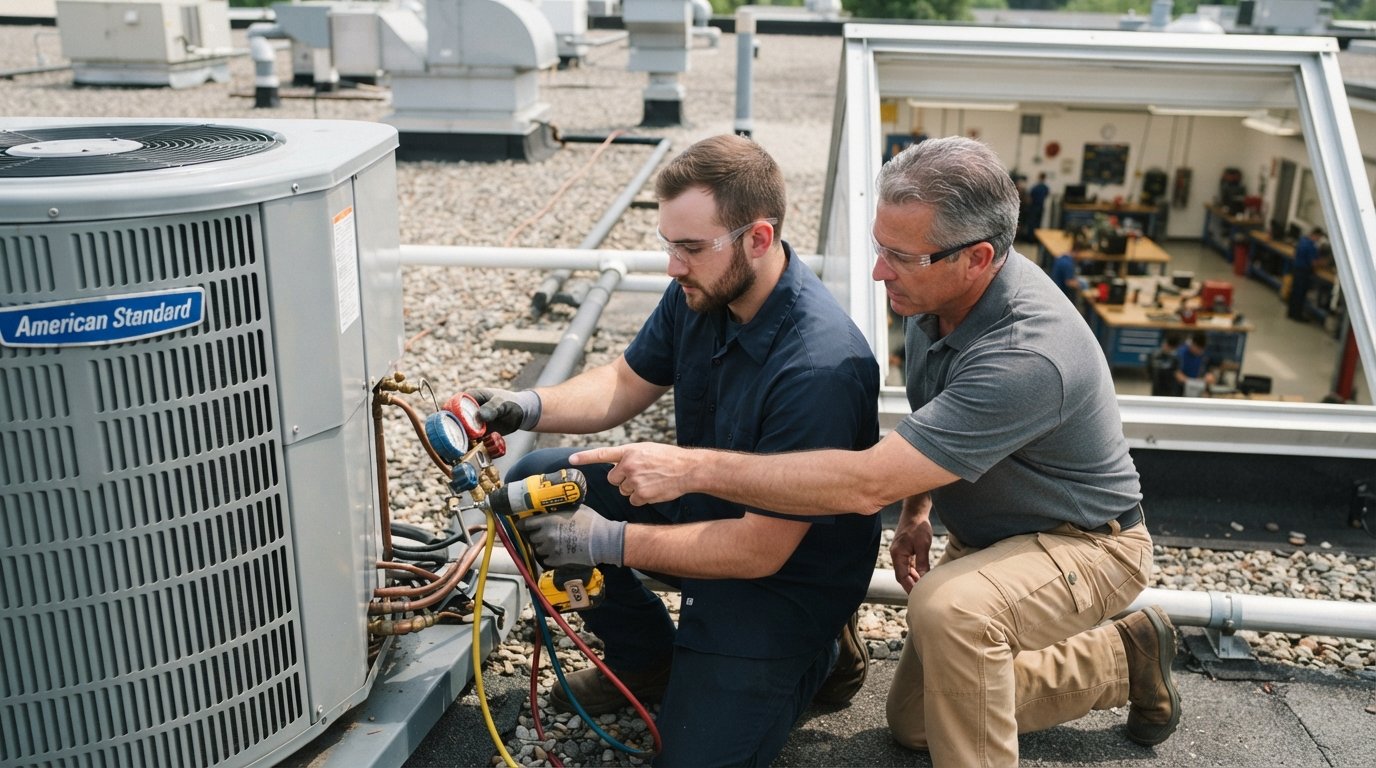
HVAC/R Certificate at Auburn Career Center: 12 Weeks
Train for an HVAC/R career in 12 weeks to under a year at Auburn Career Center. Hands-on labs and EPA prep get you job-ready fast.

By William Harris
Finding a fast, affordable path into a skilled trade can feel like searching for a needle in a haystack, especially when most programs demand two or more years of your time and thousands of dollars in tuition. The Heating, Air Conditioning, Ventilation and Refrigeration Maintenance Technology/Technician Certificate, 12 weeks to less than 1 year In-person at Auburn Career Center offers a practical alternative: a concentrated, hands-on credential that can put you on the job site or into an apprenticeship faster than a traditional associate degree. For career changers, recent high school graduates, and working adults who need to upskill without pausing their income, this short-term program deserves a close look.
This article breaks down what the certificate covers, who it is designed for, how much it costs, what careers it opens, and how to decide whether it fits your goals. It also connects the program to broader college planning and financial aid considerations, because even a short certificate is an investment that should be weighed carefully.
What Is the HVAC/R Maintenance Technician Certificate?
The Heating, Air Conditioning, Ventilation and Refrigeration Maintenance Technology/Technician Certificate is a career-focused credential that trains students to install, maintain, and repair heating, cooling, ventilation, and refrigeration systems. Unlike a full associate degree, this certificate is compressed into a window of 12 weeks to less than 1 year, making it one of the fastest routes into the HVAC/R trades. At Auburn Career Center, the training is delivered entirely in person, which matters because HVAC/R work is intensely tactile: you learn by handling gauges, torches, compressors, and control boards, not by watching videos.
Students typically study topics such as refrigeration principles, electrical theory, heating systems, air distribution, system diagnostics, refrigerant handling, and safety protocols. Many programs also embed EPA Section 608 certification preparation, which is a legal requirement for technicians who buy or handle refrigerants. The curriculum leans heavily on lab time, so graduates leave with muscle memory for common service calls rather than just textbook knowledge.
Because the certificate is short, it does not include the general education courses that pad out a degree. That is a feature, not a bug, for learners who want job-ready skills without paying for credits they will never use. However, it also means the credential is narrow by design. If your long-term goal is engineering, estimating, or business ownership, you may eventually want to stack this certificate with additional coursework. If your goal is to get hired quickly and start earning, the certificate is built for exactly that.
Why Auburn Career Center Stands Out for Hands-On Training
Auburn Career Center is a career and technical education institution with deep roots in workforce training. Its HVAC/R program is structured around the reality of the trade: technicians work in attics, crawlspaces, rooftops, and mechanical rooms, often under time pressure. In-person instruction at a dedicated career center gives students access to functioning equipment, live trainers, and instructors who have spent years in the field.
The compressed timeline is another advantage. A 12-week to less than 1 year format means you can complete training between seasonal job cycles, during a layoff, or before a planned relocation. It also means less time paying for transportation, childcare, and opportunity costs. For adult learners comparing options, that compression can be the difference between starting a new career this year and waiting until next year.
Class sizes at career centers tend to be smaller than at large community colleges, which translates into more one-on-one troubleshooting time. When you are learning to diagnose a faulty capacitor or trace a refrigerant leak, having an instructor standing next to you makes a measurable difference. This is the kind of environment where the Heating, Air Conditioning, Ventilation and Refrigeration Maintenance Technology/Technician Certificate, 12 weeks to less than 1 year In-person at Auburn Career Center delivers its strongest value: supervised repetition on real equipment.
Who Should Enroll in This Certificate Program?
The program is not for everyone, but it fits several distinct groups well. The first is the career changer who wants a skilled trade without a four-year commitment. The second is the recent high school graduate who wants to enter the workforce quickly and avoid heavy student debt. The third is the working adult in a related field, such as facilities maintenance or appliance repair, who wants formal HVAC/R credentials to qualify for higher-paying roles.
Veterans and transitioning service members are also strong candidates, since HVAC/R skills map directly to civilian infrastructure jobs and many employers actively recruit veterans. Similarly, people re-entering the workforce after a gap can use a short certificate to demonstrate current, verifiable skills to employers.
Before enrolling, consider whether the schedule and format match your life. In-person training requires reliable transportation and the ability to attend daytime or evening labs consistently. If you cannot commit to that attendance pattern, an online or hybrid option may be a better fit, though hands-on HVAC/R training is difficult to replicate fully online. You can explore flexible alternatives through resources like accredited online degree and certificate programs if your schedule makes in-person attendance impractical.
Core Skills and Curriculum You Will Learn
The curriculum in a typical HVAC/R maintenance technician certificate blends theory with extensive lab work. Early modules usually cover safety, tools, and the physics of heat transfer. From there, students move into electrical fundamentals, because modern HVAC systems are controlled by relays, contactors, thermostats, and circuit boards. Refrigeration theory comes next, followed by hands-on work with compressors, metering devices, and evaporators.
Heating modules cover gas furnaces, electric resistance heat, and heat pumps, including ignition systems and combustion analysis. Ventilation and air quality topics address duct design, airflow measurement, and filtration. Refrigeration modules often extend into commercial applications such as walk-in coolers and ice machines, which broadens employment options.
By the end of the program, a graduate should be able to perform these tasks with supervision:
- Recover, recycle, and recharge refrigerants in compliance with EPA regulations
- Read and interpret wiring diagrams and manufacturer service literature
- Use multimeters, manifold gauges, and leak detectors to diagnose faults
- Perform preventive maintenance on residential and light commercial systems
- Explain findings and repair options clearly to customers
These competencies align with what entry-level employers actually test during interviews and ride-alongs. A certificate that produces demonstrable skills, not just a transcript, is far more valuable in the trades than a generic credential.
Cost, Financial Aid, and Return on Investment
One of the strongest arguments for a short certificate is cost. Because the program lasts 12 weeks to less than 1 year, tuition is a fraction of what a two-year degree costs. That said, you should still budget for tools, safety equipment, certification exam fees, and transportation. Some employers reimburse tuition or tool costs, so it is worth asking during the interview process.
Financial aid availability depends on whether the specific program is eligible for federal student aid, which is determined by accreditation and institutional approval. Many career center programs qualify for Pell Grants, workforce development funding, and state retraining grants. Veterans may use GI Bill benefits if the program is approved. Before enrolling, contact the financial aid office and ask these questions:
- Is this certificate program eligible for federal student aid?
- Are there payment plans or workforce grants I can apply for?
- Does the program include the EPA 608 exam fee, or is that separate?
- What is the job placement rate for recent graduates?
- Can I transfer these credits into a degree program later?
Calculating return on investment is straightforward: compare total program cost against expected starting wages in your area. HVAC/R technicians commonly start above entry-level retail or food service wages, and experienced technicians with EPA certification and commercial experience can earn significantly more. If the program cost equals a few months of entry-level pay, the payback period is short. If you are considering a longer degree path later, you can compare costs and program structures using guides like Top IT Degrees for High Paying Tech Careers in 2026, which illustrates how technical credentials across fields translate into earning power.
Career Outlook and Job Opportunities
Demand for HVAC/R technicians remains steady because heating, cooling, and refrigeration are not optional in homes, hospitals, restaurants, data centers, and warehouses. The Bureau of Labor Statistics projects continued openings driven by both new construction and the need to replace retiring technicians. Climate change has also increased the frequency of extreme heat and cold events, which drives service calls.
Graduates typically enter the field through one of several routes: residential service companies, commercial mechanical contractors, facilities departments, refrigeration service companies, or appliance repair firms. Some technicians eventually specialize in building automation, energy management, or refrigeration engineering, often stacking additional certifications over time.
Entry-level roles often include helper or apprentice positions, which provide on-the-job training while you earn. Within a few years, many technicians move into lead technician, service manager, or independent contractor roles. The certificate gives you the foundational credential to start that progression; the rest depends on work ethic, customer skills, and continued learning.
How to Apply and What to Expect
Applying to the Heating, Air Conditioning, Ventilation and Refrigeration Maintenance Technology/Technician Certificate, 12 weeks to less than 1 year In-person at Auburn Career Center generally involves completing an application, providing proof of high school diploma or equivalent, and possibly taking a placement assessment. Some programs require a brief interview or advising session to confirm that the schedule and career goals align.
Once admitted, expect a structured schedule with classroom instruction, lab sessions, and possibly evening or weekend options. Attendance matters because labs build on each other; missing a refrigeration lab can set you back significantly. Budget time for homework and study, especially for electrical theory, which many students find the most challenging module.
Before your first day, confirm your tool list, textbook requirements, and any safety gear you need. Ask about internship or externship opportunities, since employer connections often lead directly to job offers. Finally, keep your certification documents organized, because employers and state licensing boards may request them.
For learners who want to compare this certificate against other short-term and degree options, it helps to think in terms of time, cost, and outcome. A 12-week to less than 1 year certificate wins on speed and direct job preparation. A two-year degree wins on transferability and broader career ceiling. Neither is universally better; the right choice depends on your timeline, budget, and long-term goals.
If you are ready to stop researching and start training, the Heating, Air Conditioning, Ventilation and Refrigeration Maintenance Technology/Technician Certificate, 12 weeks to less than 1 year In-person at Auburn Career Center is a credible, hands-on entry point into a durable skilled trade. The next step is simple: contact the career center, ask about start dates and financial aid, and visit the lab in person. Seeing the equipment and meeting the instructors will tell you more than any brochure can.